Fact Sheet on Saiga Antelope Migration
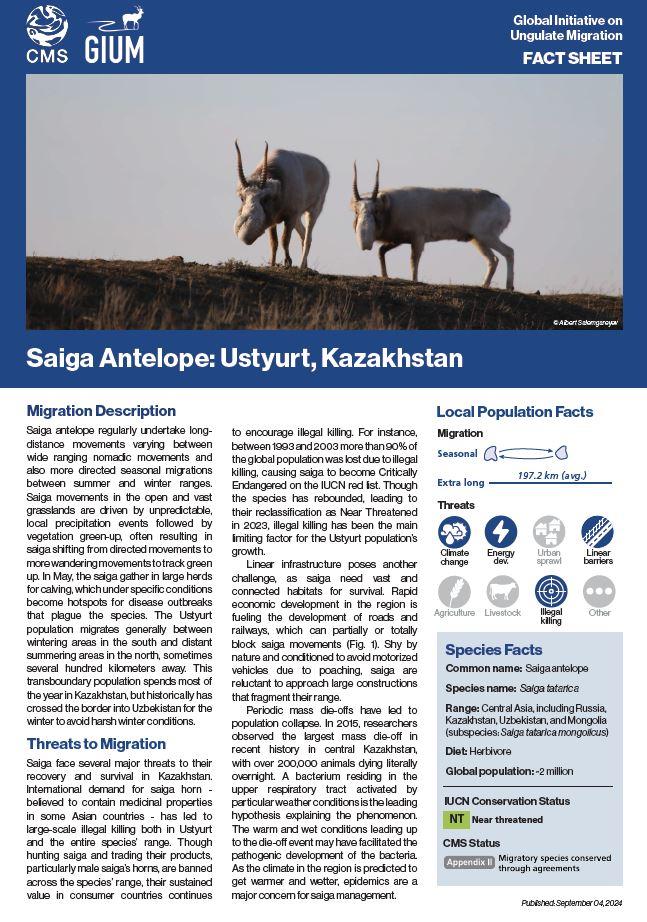
Ustyurt, Kazakhstan
Saiga antelope regularly undertake long-distance movements varying between wide ranging nomadic movements and also more directed seasonal migrations between summer and winter ranges. Saiga movements in the open and vast grasslands are driven by unpredictable, local precipitation events followed by vegetation green-up, often resulting insaiga shifting from directed movements to more wandering movements to track green up. In May, the saiga gather in large herds for calving, which under specific conditions become hotspots for disease outbreaks that plague the species. The Ustyurt population migrates generally between wintering areas in the south and distant summering areas in the north, sometimes several hundred kilometers away. This transboundary population spends most of the year in Kazakhstan, but historically has crossed the border into Uzbekistan for the winter to avoid harsh winter conditions.
Betpak-Dala, Kazakhstan
The Betpak-Dala saiga population was once the largest saiga population in the world, with historical records indicating long distance migrations occurring throughout their range in north-central Kazakhstan. In the 1990s and early 2000s, illegal killing for male saiga’s horns led to the herd’s sharp decline. In 2015, disease killed 200,000 saiga in Betpak-Dala. Combined with an increase in linear barriers, these factors caused the population to separate into two groups and their migrations to become shorter. However, conservation efforts have allowed the saiga to persist, and amidst a changing landscape they still make long distance movements necessary to their survival on the Kazakh Steppe.
Ural, Kazakhstan
The Ural saiga population in northwestern Kazakhstan is currently the largest in the world, numbering more than 1.6 million animals according to surveys conducted in 2025. Though saiga are known for making semi-nomadic migratory movements over vast distances across the Kazakh Steppe, the Ural population shows a more predictable migration pattern than the country’s other herds. The Ural population migrates generally between wintering areas in the south and distant summering areas in the north of its range in western Kazakhstan, sometimes several hundred kilometers away. Saiga typically form massive herds during May, when they gather to give birth on calving grounds that may vary year to year. The Ural population typically calves within a one to two week period in the northernmost extent of its migratory range. They then roam the steppe throughout the summer, tracking precipitation events and vegetation growth. In the early fall, the saigas move south towards their traditional rut area and winter range. Snow depth is an important driver in their winter migrations, and may determine how far south they travel to find milder conditions and sufficient forage. This transboundary population spends most of the year in Kazakhstan, but may cross the border into Russia during its spring migration.
| Attachment | Size |
|---|---|
| Fact_Sheet_on_Saiga_Antelope_Migration_Ustyurt_KAZ.pdf | 2.19 MB |
| Fact_Sheet_on_Saiga_Antelope_Migration_BetpakDala_KAZ.pdf | 2.32 MB |
| Fact_Sheet_on_Saiga_Antelope_Migration_Ural_KAZ.pdf | 2.11 MB |